VideosGeneral Education
Julius Rosenwald & Booker T. Washington: The Secret of Resilience and Empowerment by Robert Woodson
Robert Woodson delivered these remarks at the 2025-2026 series of the Levy Forum […]
The ancient Greeks identified seven subjects that made up a traditional liberal arts education, which they considered essential for a free person to study in order to participate in civic life and cultivate virtue. The original seven subjects were grammar, logic, and rhetoric, (the trivium) and arithmetic, geometry, music, and astronomy (the quadrivium). The medieval Western universities followed suit and heavily influenced the development of higher education in the United States.
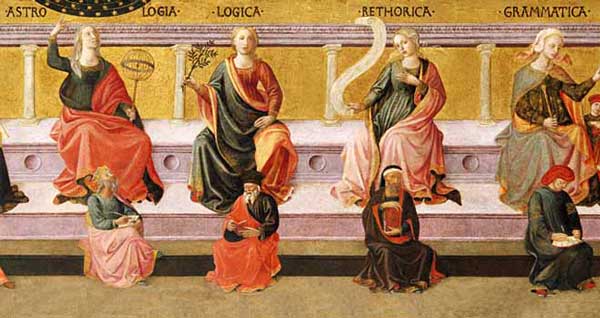
Liberal arts education, grounded in classical languages and literature, persisted for hundreds of years, but has started to fray. Today, higher education faces a new contemporary crisis: What is a liberal arts education?
A new study reveals that more than eight in 10 provosts believe that the concept of a liberal arts education is not understood in the United States, even though 87% believe that liberal arts education is crucial to an undergraduate education. The understanding of what a liberal arts education consists of is so unclear because higher education has abandoned a unanimous consensus on the concept. The definition of a liberal arts education is now left to the discretion of individual colleges and universities.
Grinnell College, for example, states, “The College provides an education in the liberal arts through free inquiry and the open exchange of ideas,” but Grinnell does not require specific courses in the liberal arts. All Grinnell students develop an individually advised curriculum. Grinnell boasts, “With just one required class, and more than 500 course offerings, and no general education requirements or core curriculum, you can explore your interests through all their twists and turns.”
In contrast, Regent University declares, “Students encounter a liberal arts experience that prepares them to think, to inquire about ideas and the nature of the world, and to seek and analyze information.” Regent requires all students to complete courses in mathematics, natural science, Western theology and literature, economics, art, and American government and history.
It is no wonder that a liberal arts education is not well understood in the United States. Grinnell characterizes the liberal arts as a fluid, personal experience, while Regent conceives of the liberal arts as a specific, structured curriculum. Unfortunately, more Americans are likely to define the liberal arts as the former rather than the latter. Literature and foreign language study, for example, were once considered essential elements of a classical liberal arts education. However, What Will They Learn?®, an annual assessment of the general education requirements at over 1,100 colleges and universities, shows that only 32% of American institutions surveyed require literature, and a measly 12% require intermediate foreign language study.
Students who are seduced by Grinnell’s understanding of the liberal arts pay a lofty price for their mistake. To be more precise, a $136,048 mistake assuming students complete a baccalaureate degree in four years. The annual tuition rate at Grinnell is $52,392, compared to $18,380 at Regent. Students at Regent are more likely to pay much lower tuition and graduate better prepared for rewarding careers, engaged citizenship, and meaningful community participation.
Students should no longer pay the price for academia’s bewilderment. Higher education leaders must restore the classical definition of the liberal arts. A classical liberal arts education equips students with the skills necessary to participate in civic life and examine humanity’s timeless challenges. Students once studied Latin because doing so improved their understanding of grammar. They studied literature because Homer’s Iliad and Odyssey examine the immense complexities of human nature. These fundamental lessons transcend 2,000 years of history and are the necessary prerequisites for a healthy democratic society. Colleges and universities owe it to their students to reunite under the classical liberal arts.
Nathaniel Urban is the associate director of curricular improvement at ACTA.
Robert Woodson delivered these remarks at the 2025-2026 series of the Levy Forum […]
The American Council of Trustees and Alumni (ACTA) annually assesses core curricula at over 1,100 U.S. colleges and universities as part of our What Will They Learn? project. Each school is assigned a letter grade based on seven core subject areas. As one of the most significant improvements recorded this year, New College of Florida has skyrocketed from an F to a B+ rating. By achieving a B+, it comes in the top 7.5% grades nationwide, and is now the highest-graded public school in Florida.
Andrew Ollett, an associate professor at the University of Chicago, used to wear a t-shirt that read “Sanskrit or die (pāṇḍityaṁ śaraṇaṁ vā mē mr̥tyur vā).” Referring to an ancient language from South Asia, Dr. Ollett’s shirt captured the spirit of the institution. Students dub it the university “where fun goes to die” because of […]
Launched in 1995, we are the only organization that works with alumni, donors, trustees, and education leaders across the United States to support liberal arts education, uphold high academic standards, safeguard the free exchange of ideas on campus, and ensure that the next generation receives an intellectually rich, high-quality college education at an affordable price.
Discover MoreSign up to receive updates on the most pressing issues facing our college campuses.