Don’t be a Limestone University. After years of falling enrollment, the small South Carolina school relied on exorbitant spending to stay open. Even after layoffs, expanding online programs, and a fundraising campaign, Limestone could not make it work and announced that the class of 2025 would be its last.
While the attempt to save the institution was likely made in good faith, an article in Higher Ed Dive noted the uncomfortable truth: By planning ahead and better stewarding its resources, Limestone University could have merged with another institution, leaving its students, faculty, and the campus community in a much better position. Now, the damage is done and the university is no more. As many other schools face falling enrollment, they can learn from Limestone’s missteps.
Limestone’s Falling Enrollment Reflects National Trends
Limestone University had been losing students consistently from its peak enrollment in 2011, when it had a full-time equivalent enrollment of almost 3,000. In its last year, the school had just 1,500 undergraduates.
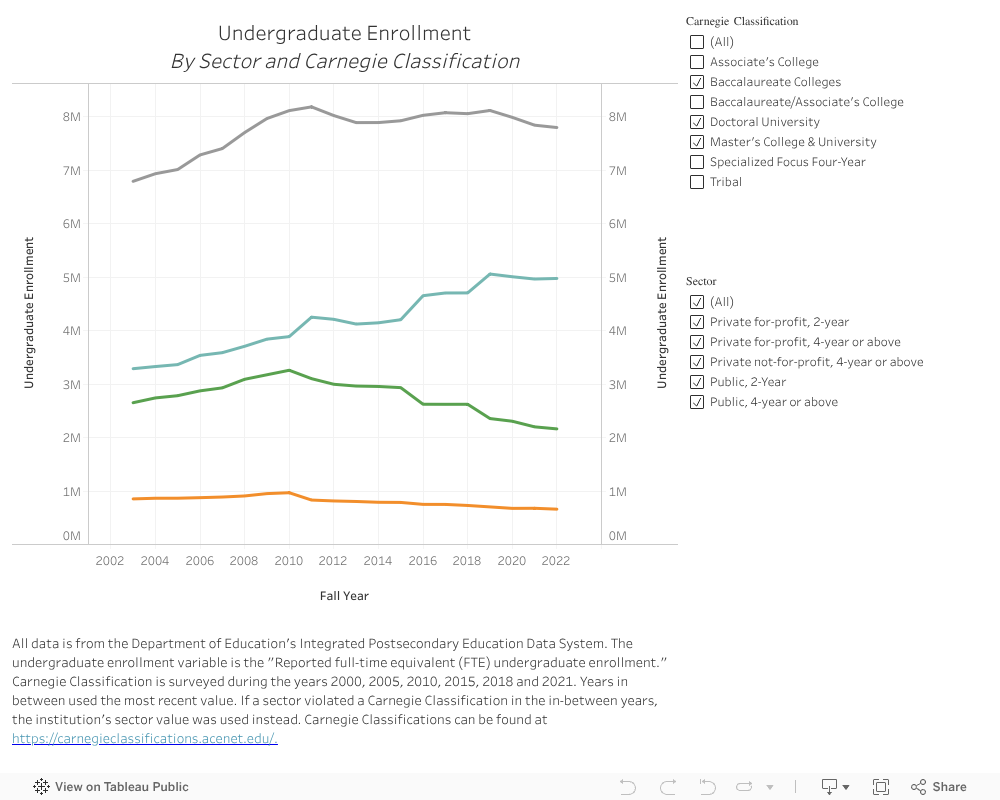
This trend may feel familiar to other institutions. Since the 2010–2011 academic year, total undergraduate college enrollment continued to rise, but at a slowing pace. This was in part due to changing demographics but also likely because as the economy strengthened following the 2008 recession, students were tempted away from the classroom.
The enrollment slowdown did not impact all colleges equally. Undergraduate enrollment at four-year public and private nonprofit colleges and universities began to diverge in 2010, when enrollment at doctoral institutions, indicated by the blue line in the chart below, continued to grow, while enrollment at colleges that grant master’s degrees, indicated by the green line, began to fall. The same is true for baccalaureate colleges like Limestone University: Enrollment at both public and private institutions continued to fall.
Declining Enrollment Is a Warning Sign
One of the reasons falling enrollment is so dangerous is that it has been found to be a predictor of whether or not a college will eventually close. While colleges bring in multiple forms of revenue, tuition and fees make up a larger portion of revenue at smaller institutions than at larger ones. Additionally, many colleges’ expenditures rely on fixed costs. If a college sees a large drop in enrollment, and thus, tuition dollars, it is difficult quickly to sell a building or dining hall to make up the cost.
Of course, enrollment is only one variable, and many master’s and baccalaureate colleges have maintained or increased their enrollment in the past decade, whether by growing a college’s sense of community or using data analytics to reach more students. Southern New Hampshire University and Western Governors University, both master’s degree-granting institutions, have implemented online degree programs and seen enrollment skyrocket.
Exacerbating current enrollment woes is the inevitable drop in high school graduates and thus college enrollees. Birth rates declined in 2008 during the recession and never rose back to pre-recession levels. The coming year marks the beginning of the associated drop in high school graduates. Colleges as a whole will have a smaller pool of students to choose from, forcing some to make hard choices.
What to Do
In an attempt to survive as enrollment dwindled, Limestone spent nearly $50 million between 2020 and 2022, an amount an auditor called “uncontrollable,” and eventually began using endowment funds to continue operating. This led to a collapse in the total value of the college, likely scaring away any potential partnership with another school.
Maintaining a realistic outlook will help administrators make hard decisions now in the best interests of their students, rather than resorting to unsustainable spending followed by abrupt closure. Colleges only have so much control over enrollment. But they do have control over their spending and plans for the future. College leaders who take a hard look at their budgets now can begin identifying mergers, partnerships, and other innovative solutions that will allow them to fulfill their promise to their students.