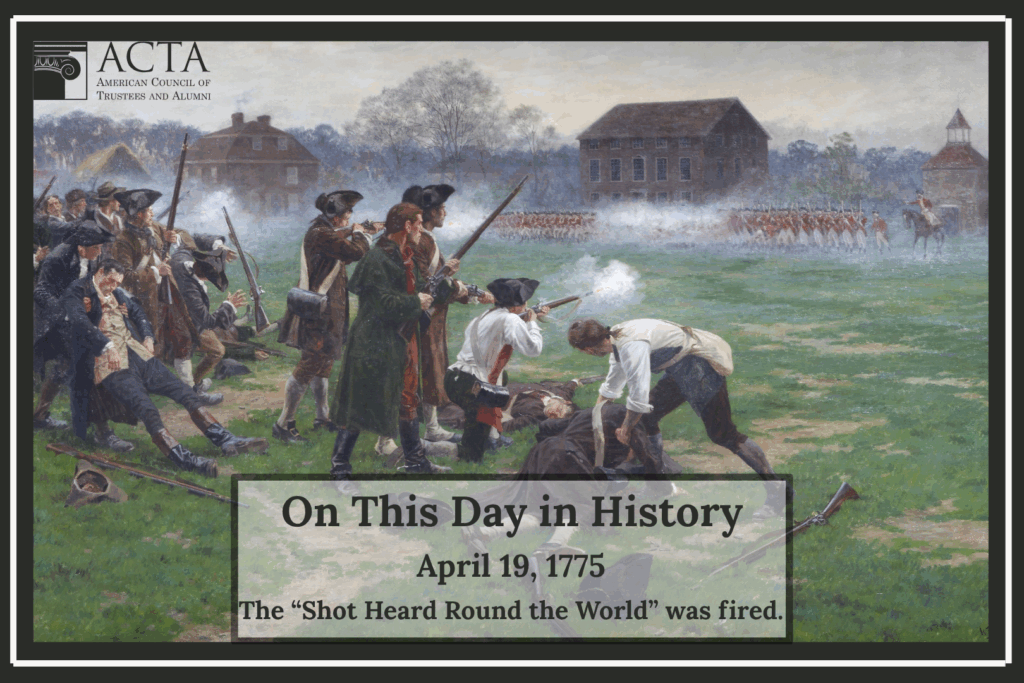
On the morning of April 19, 1775, British troops and colonial minutemen fired on each other at the battles of Lexington and Concord. Referred to eloquently in Emerson’s poem, “Concord Hymn,” as “the shot heard round the world,” this event officially started the American Revolutionary War and paved the way for independence. The minutemen in Massachusetts fought and died for liberty and self-governance, principles on which this country was founded. Sadly, many Americans, even those with a college education, are ignorant of their nation’s history and founding principles. This is not only disappointing but dangerous to national solidarity. It must be rectified to ensure the continued stability and success of the United States.
Ordered to destroy weapons hidden by colonists at Concord, 700 British soldiers set out from Boston on the evening of April 18, 1775. Warned of their advance, Captain John Parker and 70 minutemen gathered in Lexington at dawn to face them. During the initial charge, an unidentified shot ran out, which triggered a volley from the British that killed seven of Parker’s men. The redcoats continued to Concord but were astonished to see nearly 400 minutemen marching towards them. Alarmed, they opened fire. The colonists responded similarly and, with aid from more volunteers, succeeded in routing the British troops back to Boston. Against all odds, the “embattled farmers,” as Emerson termed them, were victorious. It was their initial courage that created a new nation, and their sacrifice must never be forgotten.
“Those who cannot remember the past are condemned to repeat it.” Written by philosopher George Santayana, this statement holds a timeless truth—one recognized by the Founding Fathers when forming this country’s government. Called an “experiment” by the Founders, America’s system of government was innovative and unique: a democratic republic. Determined not to repeat the mistakes of their predecessors, the Founders studied philosophies and regimes from ancient Greece and Rome to the Enlightenment and their former motherland, Great Britain. The outcome of their labor was a government rooted in inherent human rights, which will have lasted 250 years as of this July 4.
Unfortunately, this “great experiment” is now under threat from the ignorance of its own citizens. The American Council of Trustees and Alumni’s (ACTA’s) What Will They Learn?® (WWTL) project grades U.S. higher education institutions on their core curriculum requirements. WWTL found that only 19% of colleges currently require students to take a course in U.S. government or history, and only 14 states require such a course to be taken at their public institutions. Young Americans are not receiving a thorough civic education, and the results are worrying. In 2024, Losing America’s Memory 2.0, a survey conducted by ACTA and College Pulse, found that most college students could not answer basic questions about their nation’s history and government. For example, only 32% of those surveyed knew when the U.S. Constitution was written, and only 22% identified republicanism as a core principle of American civic life.
This lack of knowledge, especially among those who have reached voting age, is concerning. Historian David McCullough once said, “History shows us how to behave. History teaches, reinforces what we believe in, what we stand for, and what we ought to be willing to stand up for.” History provides citizenry with a firm grounding in facts and analysis so they can face current issues successfully. In contrast, historical ignorance produces a public that is easily swayed by falsehoods and emotional rhetoric and willing to dismiss its past and heritage as flawed and unimportant. This outlook is not only untrue but, as McCullough states, a “form of ingratitude.”
For 250 years, men and women have poured their energy into constructing and defending the United States and what it stands for: life, liberty, and the pursuit of happiness for all. This country is here today due entirely to their efforts and even, as in the case of Lexington and Concord, their lives. Every American citizen shares the duty to learn about and responsibly participate in their nation’s government, because, as Professor of Humanities Allen Guelzo succinctly stated, “The good citizen is someone who understands that they are the place where government begins.”