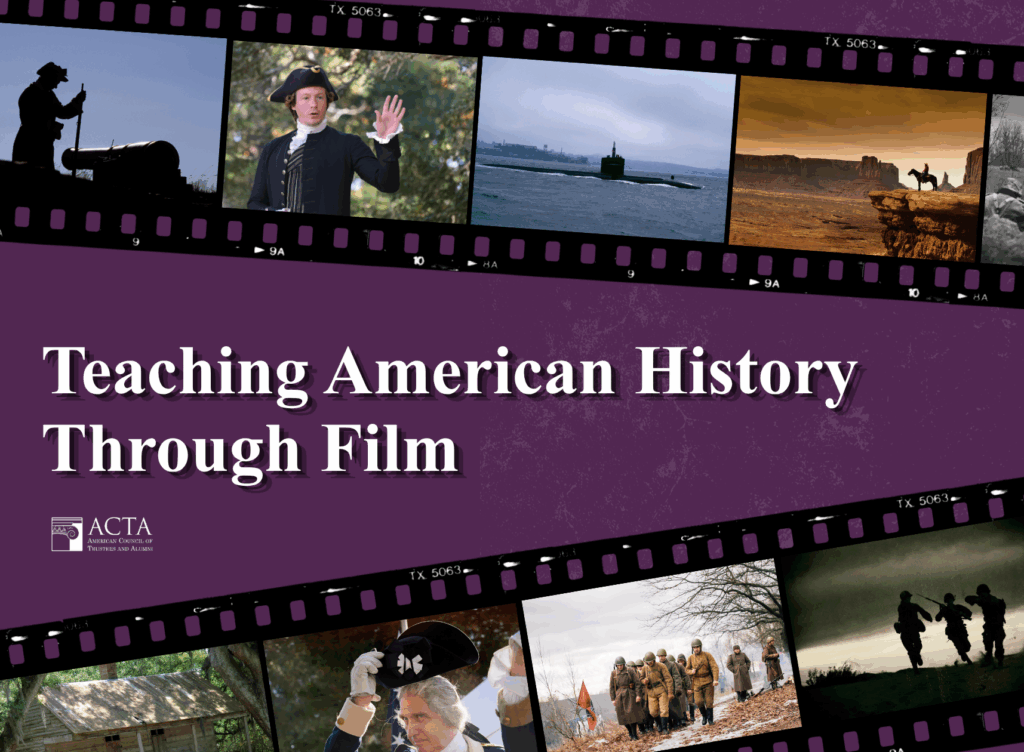
A symbiotic relationship exists between the stories a nation tells and its civic identity. Popular culture is never neutral; it reflects the assumptions, priorities, and perspectives of its time. As those stories circulate, they do more than entertain—they influence how audiences interpret both the past and the present.
That reality—studied by scholars for decades—should guide how we think about films centered on historical events in the lead-up to America’s semiquincentennial on July 4, 2026, especially at a moment when Americans may be watching visual depictions of history more often than reading narratives about it.
Feature films telling historical stories can serve as compelling entry points into the past. They humanize distant figures, illuminate difficult choices, and bring to life moments that textbooks often struggle to animate. I still remember sitting in an eighth-grade classroom, riveted by TriStar Pictures’s Civil War film Glory (1989), which brought the story of the 54th Massachusetts Regiment vividly to life. Later, HBO’s Band of Brothers (2001) and the John Adams (2008) miniseries sparked fascination and reverence for other historical figures and events.
But those experiences worked because they were beginnings, not endpoints. Films can ignite curiosity, but they cannot carry the full weight of historical context and understanding. That limitation is especially consequential now, when America is experiencing measurable civic and historical illiteracy. When civic memory erodes, popular culture can and will begin to “educate” by default.
The question, then, is not whether we should use film to tell historical stories, but how—and how we should teach them.
Fortunately, educators and historians have developed pedagogical practices for using historical film not as a substitute for history, but as a gateway into it.
First, historical films should be framed, not simply shown. Effective instructors provide context before viewing: what the film gets right, where it compresses events, and what questions students should consider. Without that framing, narrative can easily be mistaken for fact.
Second, historical films should be interrogated, not passively consumed. Students should be encouraged to treat movies as interpretations, asking: What perspective does this film present? What is emphasized or omitted? Whose voices are centered, and whose are missing?
The most effective classrooms pair historical films with deeper inquiry, which includes discussion, writing, and engagement with primary texts. In this way, film becomes an object of analysis rather than a vehicle for unexamined absorption.
Third—and perhaps counterintuitively—a historical film’s inaccuracy can be a feature, not a bug. When used deliberately, historically flawed films can sharpen critical thinking. Comparing dramatized scenes with primary sources teaches students how history is constructed, revised, and sometimes distorted.
Finally, educators should be selective. Not every historical film advances historical understanding equally. Careful curation—choosing works that illuminate complexity rather than flatten it—is essential if cinema is to support, rather than undermine, historical literacy.
Films recognized for their historical seriousness, such as Saving Private Ryan (1998) and 12 Years a Slave (2013), can help students grapple meaningfully with the past. Other historical films—including forthcoming 2026 films like Pressure, Young Washington, and The Brink of War—provide opportunities for deep critical analysis of representation and timeline. Documentaries like Ken Burns’s The American Revolution (2025) can add further depth, helping students compare cinematic storytelling with historical evidence and interpretation.
These practices point to a larger truth: film is most impactful not when it replaces traditional learning, but when it complements it. Research in social studies education shows that, when used deliberately, film can strengthen historical empathy, deepen interpretive skills, and increase student engagement.
Furthermore, historically grounded films can cultivate what President Ronald Reagan called “informed patriotism”—not uncritical celebration, nor reflexive cynicism, but a form of civic attachment grounded in understanding.
That distinction matters as the nation approaches its 250th anniversary.
America does not need jingoism, nor cynicism masquerading as sophistication. It needs citizens capable of engaging their history with clarity, humility, and judgment. Film, because of its emotional power, can either contribute to that project or undermine it.
In this sense, film is not just entertainment. It is a vehicle for historical, intellectual, and cultural engagement—one that shapes how we understand ourselves and our history. By treating it as a starting point for inquiry, we can strengthen the habits of mind that self-government requires.
The opportunity before us is not simply to commercialize or commemorate the past, but to understand it more fully. That is a task worthy of both Hollywood and the classroom.