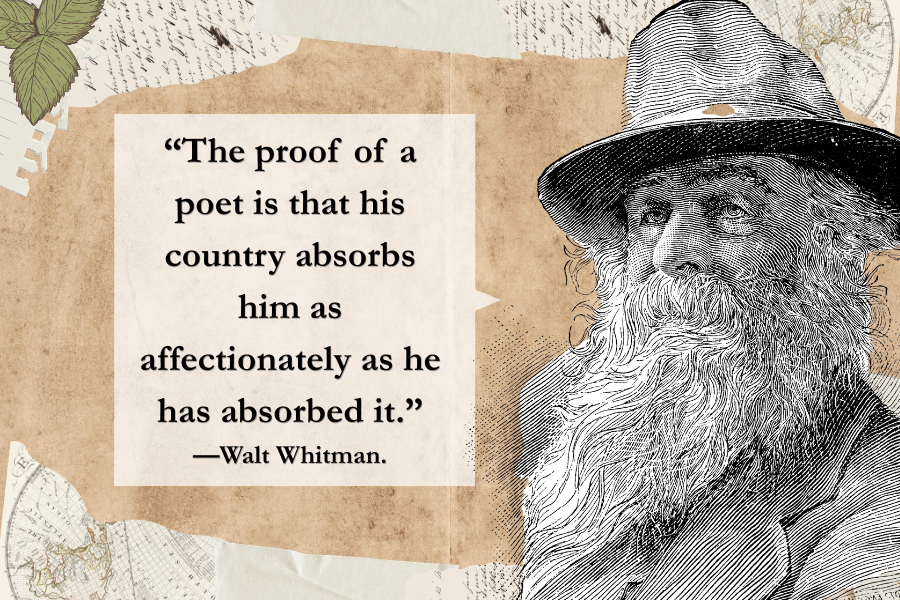
For Walt Whitman, late spring was more than just a season. It symbolized growth, possibility, and democratic renewal. As June begins, it is worth returning to a poet whose work sought the spirit of the United States itself and what it means to be an American citizen.
Born on May 31, 1819, Whitman entered a United States still unsure of its identity as a nation. Largely self‑educated, Whitman worked as a printer, writer, and editor, forging himself into an author outside formal academic institutions. Yet few writers have done more to imagine what America was—and what it might become. Drawing deeply from everyday life, Whitman transformed common experience into literature of remarkable ambition. He sought to create a distinctly American voice capable of holding the nation together amid the political and cultural tensions of his time. This connection between Whitman and a young America set the stage for his most influential work, Leaves of Grass.
First published in 1855, Leaves of Grass was a slim volume comprising 12 untitled poems and a 10-page preface. Interestingly, more than half the book consisted of a single poem, later titled “Song of Myself.” This imbalance was intentional. Whitman was not offering a polite collection of verses; he was making a poetic argument about the relationship between the individual and the nation. Inspired by his travels across the American frontier and by Ralph Waldo Emerson’s call for a distinctly American poet, Whitman did not merely describe the country around him; he sought to give America a voice capacious enough to absorb its contradictions and conflicts.
Whitman never abandoned that goal. Over the next several decades, he revised and expanded Leaves of Grass repeatedly, culminating in the 1892 “deathbed edition,” which contained nearly 400 poems. Across its many versions, Whitman articulated a vision of the self that is expansive rather than isolated, a democracy grounded in shared humanity, and a nation bound together not by differences, but by a “grand democracy of souls.” In doing so, Whitman reshaped American poetry and helped redefine literature’s relevance within civic life.
Reading Whitman is not always easy, and that challenge is precisely the point. His poetry resists quick summary and simple conclusions. It requires close attention to language, form, and ideas. It rewards rereading, and it forces readers to grapple with questions about identity, individuality, and the meaning of democracy. Those who engage meaningfully with Leaves of Grass learn not what to think, but how. They learn how to follow a complex argument and connect personal experience to broader civic and national concerns.
That kind of intellectual formation sits at the heart of a liberal arts education. Taken together, these qualities explain why Whitman belongs not as an elective curiosity, but as a required encounter, particularly in undergraduate education. The study of literature within the liberal arts is not about extracting a single message or reinforcing ideological certainty. It is about cultivating habits of careful reading, sustained attention, intellectual independence, and thoughtful disagreement. These are skills students need to understand themselves and participate responsibly in civic life.
The American Council of Trustees and Alumni advocates those same skills through its What Will They Learn?® (WWTL) project. By examining whether institutions require students to engage with demanding, foundational texts, WWTL asks a simple but urgent question: Are colleges ensuring that students encounter work that challenges them, deepens their understanding of democracy, and prepares them for informed citizenship?
WWTL’s findings show that, too often, higher education institutions treat the humanities as optional and secondary to career preparation. Whitman’s work reminds us that education is not merely about workforce readiness. A university education should also prepare students to think critically about themselves and their country. Literature, history, and the broader liberal arts remain essential because they cultivate intellectual independence that extends far beyond the classroom.
Whitman believed that democracy required more than laws and policies; it required citizens capable of empathy and critical thought. His work shows us that higher education should do more than prepare students for a profession; it must prepare them to engage seriously with ideas and the responsibilities of citizenship.