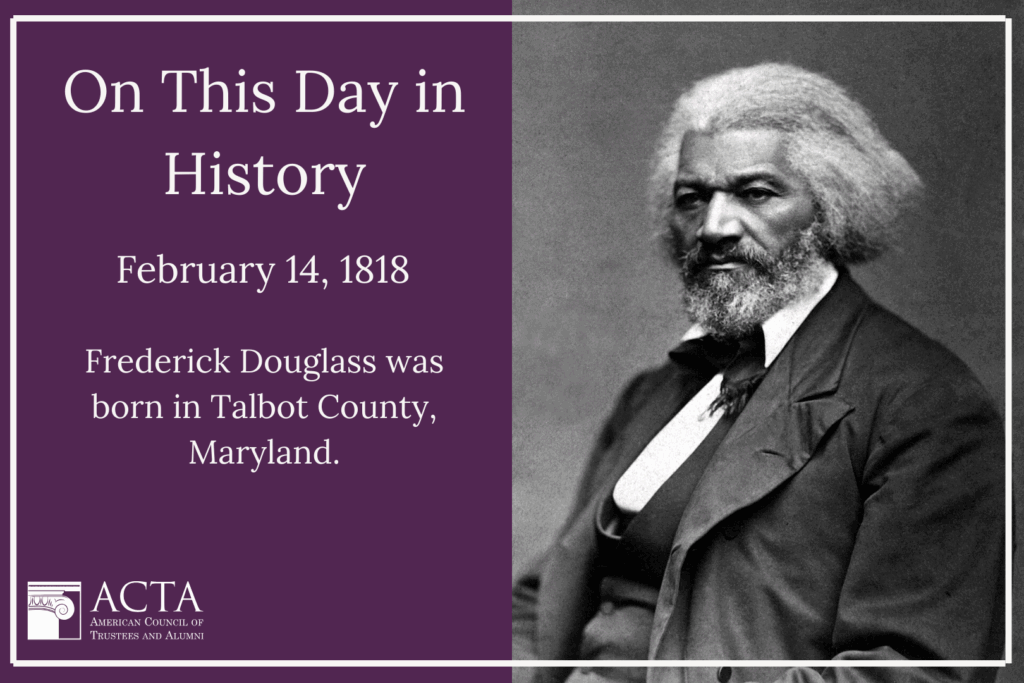
Frederick Douglass was born to Harriet Bailey, an enslaved field hand in Talbot County, Maryland, and an unknown father, probably of European descent. Although his exact birth date is unknown, Douglass was told by his former owner that he had been born in February 1818, and he later proceeded to celebrate his birthday on February 14 alongside Valentine’s Day. A fierce orator, ardent abolitionist, and brilliant thinker, Douglass eventually won his freedom and became one of our nation’s greatest proponents of the Constitution and the importance of education.
The secret to his great success was his love of learning. In 1826, Douglass was sent to live in Baltimore with Hugh and Sophia Auld. Tasked with looking after their son Thomas, he sat in on the boy’s lessons. Unfortunately, Hugh Auld subsequently forbade his wife from teaching Douglass, lest she “spoil” the young slave. This injustice only hardened his resolve to learn. According to the Encyclopedia Brittanica’s biography of Douglass, he continued teaching himself to read by “exchanging bread for lessons from the poor white boys he played with in the neighborhood and by tracing the letters in Thomas’s old schoolbooks.” He purchased The Columbian Orator, a grade school rhetoric textbook with excerpts from great orators including Cicero and Benjamin Franklin. He also read the Bible and scoured every book and newspaper he could find. “Knowledge,” he later famously said, “makes a man unfit to be a slave.”
After being sold to several different owners, Douglass finally escaped bondage in 1838 by disguising himself as a sailor and fleeing north to New York City. There, he began reading the abolitionist newspaper, The Liberator,and attended an American Anti-Slavery Society convention in Nantucket in 1841. Abolitionist William C. Coffin invited Douglass to address the gathering, and his spontaneous speech was so moving that he was offered membership in the group. Over the next few years, he gained public recognition by giving similar addresses on his experiences as a slave and the power of moral persuasion in changing attitudes toward slavery.
In 1845, he released his first autobiography, Narrative of the Life of Frederick Douglass, an American Slave, Written by Himself, and in 1847, he began publishing his own newspaper, The North Star. It was during this time, particularly before the outbreak of the Civil War, that Douglass began to engage in the debate over whether the U.S. Constitution was pro- or anti-slavery. He eventually concluded, “interpreted as it ought to be interpreted, the Constitution is a GLORIOUS LIBERTY DOCUMENT. . . . I defy the presentation of a single pro-slavery cause in it. On the other hand it will be found to contain principles and purposes, entirely hostile to the existence of slavery.”
Douglass fought a lifelong battle to ensure that the liberties enshrined in the Constitution could be enjoyed by all Americans. He consulted with Abraham Lincoln on the treatment of black soldiers during the war; advocated for the Fourteenth and Fifteenth Amendments, which granted blacks citizenship and the right to vote; promoted women’s suffrage; and supported President Ulysses S. Grant and the Civil Rights Act of 1871. He was the first former slave to hold multiple government positions, including as first black U.S. marshal under President Rutherford B. Hayes, recorder of deeds for Washington, DC, under President James A. Garfield, and consul-general to the Republic of Haiti under President Benjamin Harrison. He continued to deliver speeches throughout the country on freedom, education, and equality and was preparing one such lecture when he suffered a fatal heart attack on February 20, 1895.
All of Douglass’s writings, speeches, and books are full of allusions to the greatest ideas and thinkers of Western Civilization, from Socrates to the Apostle Paul to Shakespeare. His self-taught knowledge of history, literature, and the Founders informed his powerful critique of slavery and his eloquent defense of liberty. It is this same classical foundation that ACTA advocates through our What Will They Learn?® project. To shape the great citizens and reformers of the next generation, colleges and universities must ensure their students take a well-rounded core curriculum in the liberal arts that includes study of literature, composition, U.S. government and history, and other essential disciplines.