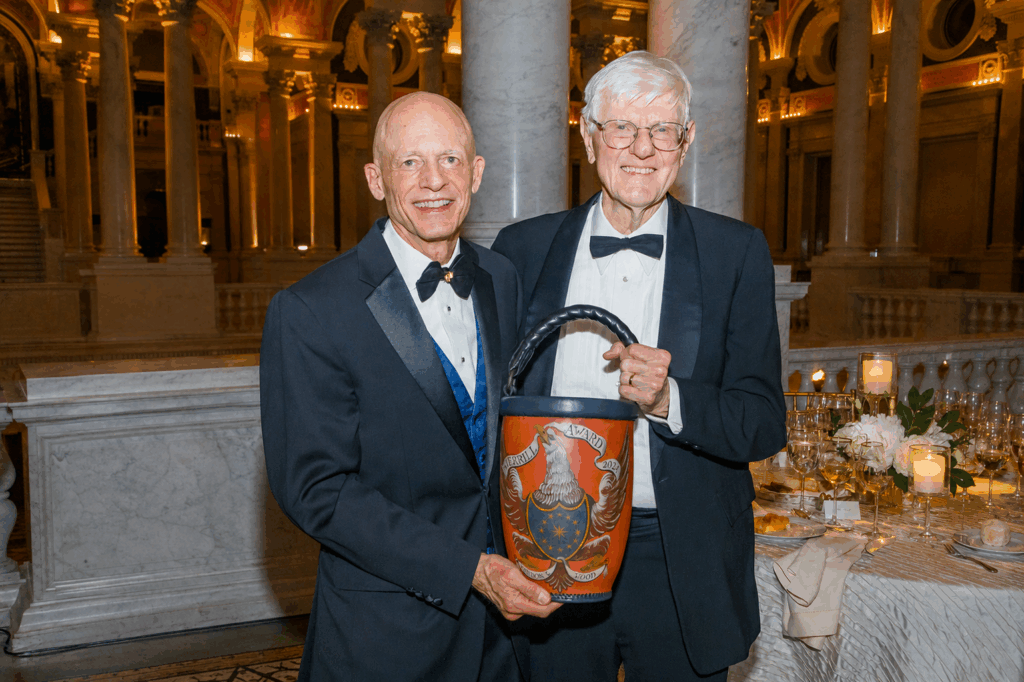
ACTA mourns the passing of Professor Gordon S. Wood, one of the very greatest historians of the American founding and a cherished friend to this organization. He died on June 7 at the age of 92, and his loss is felt deeply—by the academy, by the nation, and by all of us who looked to him as a model of what serious, civic-minded scholarship can and should be.
Professor Wood dedicated his career to illuminating the ideas, struggles, and ideals that gave birth to the American republic. His scholarly achievements are without peer in the field: his landmark work The Creation of the American Republic, 1776–1787 earned the Bancroft Prize in 1970, and The Radicalism of the American Revolution earned him the Pulitzer Prize for History in 1993. He held a Guggenheim fellowship, was awarded the National Humanities Medal by President Obama in 2010, and served on the faculties of Brown University, Harvard University, the University of Michigan, and William & Mary. What distinguished him, beyond the accolades, was his rare gift for writing history that was both rigorously accurate and accessible—a combination that brought the founding generation to life for professional historians and general readers alike. He was consistently generous with his time, speaking to groups of schoolteachers, students, and all others who sought to understand the heritage of our nation.
ACTA was honored to present Professor Wood with the Philip Merrill Award for Outstanding Contributions to Liberal Arts Education in 2022, at our Anniversary Celebration at the U.S. Library of Congress. It was a fitting recognition. Professor Wood understood, in a way that was both deeply scholarly and deeply patriotic, that a meaningful liberal arts education must include an honest and thorough encounter with American history and the principles of American self-government. His award acceptance address, “1776, Out of Many One,” embodied that conviction: a meditation on America’s founding, on the meaning of national identity, and on the importance of getting history right. That commitment extended beyond a single speech. Professor Wood went on to serve on ACTA’s National Commission on American History and Civic Education, lending his formidable expertise to our efforts to reverse the civic illiteracy crisis rampant on our college campuses. We were grateful for his participation then, and we remain grateful now for the wisdom he so generously contributed to this work.
That wisdom was not merely academic. Professor Wood’s patriotism was profound, and he believed that understanding the American founding was essential to understanding America itself: its character, its tensions, its possibilities. In a Wall Street Journal article last November, he urged Americans to mark the nation’s semiquincentennial by reflecting on what makes the United States truly unique, reminding his audience: “To be an American is not to be someone, but to believe in something.” It is a sentiment ACTA has long embraced, and one that captures precisely why his scholarship matters so much, not only to the historical profession, but to the ongoing work of educating citizens who understand their inheritance. That sentiment animated much of Professor Wood’s work. As he wrote in The Idea of America, “However many troops we can muster around the world will mean little if, in using them, we erode that idea, that moral authority which is the real source of our strength and our ability to gain the admiration and support of other peoples.” For Professor Wood, the preservation of America’s founding ideals was not merely a matter of historical interest, but of national character and civic responsibility.
Professor Wood embodied the highest ideals of liberal arts education: meticulous in his research, fearless in his conclusions, and committed to bringing the life of the mind into genuine contact with the life of the nation. ACTA has looked to him as an inspiration, and we will continue to be guided by the standard he set. We extend our deepest condolences to his family, his friends, and all those whose understanding of America was shaped by his extraordinary work. As we honor his legacy and continue the work to which he devoted his life, we are reminded of a longing he expressed in The Idea of America: “We can only hope that that idea of America will never die.”
WHO WE ARE
Launched in 1995, we are the only organization that works with alumni, donors, trustees, and education leaders across the United States to support liberal arts education, uphold high academic standards, safeguard the free exchange of ideas on campus, and ensure that the next generation receives an intellectually rich, high-quality college education at an affordable price.
Discover MoreSTAY INFORMED
Sign up to receive updates on the most pressing issues facing our college campuses.