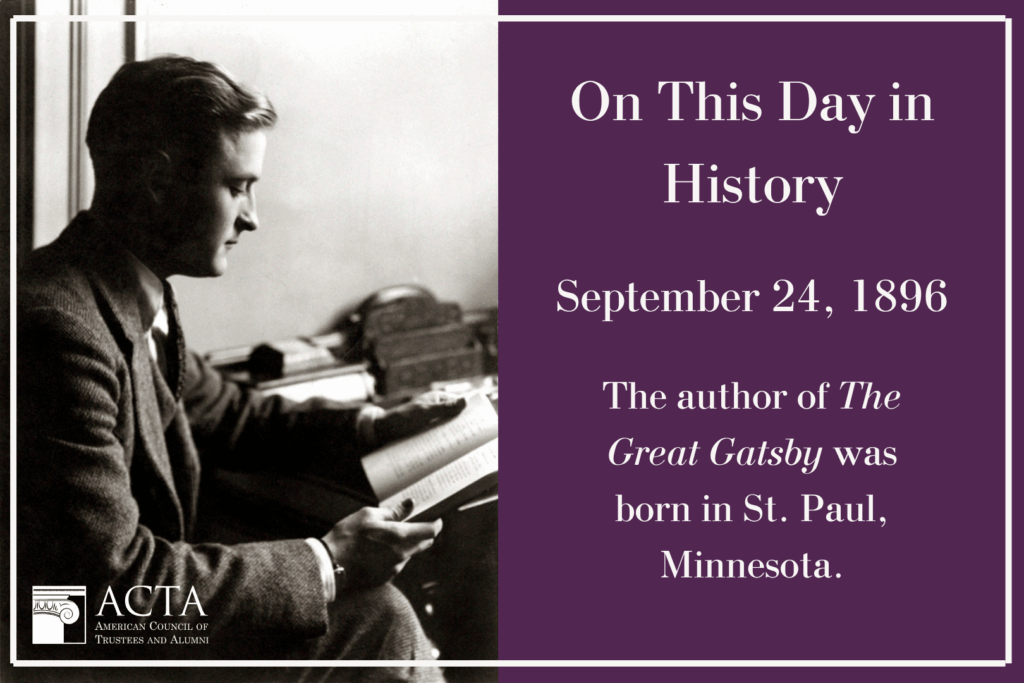
The first half of the twentieth century was a turbulent time for the United States. In the 31 years between 1914 and 1945, the country experienced a major economic boom, the Great Depression, and two world wars. It was an era marked by uncertainty and instability for its citizens, especially for the writers who reached maturity during World War I. One member of this Lost Generation, born on this day in 1896, was F. Scott Fitzgerald. Fitzgerald’s short stories and novels focus on the shifting social, political, and economic movements during this period. His literature offers modern readers a glimpse into the unique challenges faced by the Lost Generation.
During Fitzgerald’s childhood, American culture retained many Victorian sensibilities in its understanding of gender and class. These social categories determined what one could do and whom one could associate with. Because Fitzgerald was born into a Midwestern middle-class family, he was unable to join those in higher society. He felt these social restrictions at Princeton, where a woman severed romantic ties with him due to his lower status, and again in 1919, when his eventual wife, Zelda, nearly broke off their engagement because of his inadequate income. As a result, the young writer was always class-conscious. He captured the snobberies of the period’s class structure vividly in his first novel, This Side of Paradise. The protagonist, Amory Blaine, is constantly classifying and being classified at Princeton with terms such as “sweaty bourgeois,” “superior class,” and “a Princeton slicker.” These phrases illustrate society’s focus on family background and appearances, and how it affected individuals. However, with the end of the First World War, these values were about to change.
Progressive, vibrant, and jazz-filled, the Roaring Twenties were everything the Victorian period was not. With the economy booming after the war, the middle class had new money to spend. With new career opportunities and the ability to vote as of 1920, women were more independent and relaxed with their language and appearance. Gaining instant celebrity after the success of his first novel, Fitzgerald and his wife were Jazz Age icons. The couple led an extravagant and unstable lifestyle that epitomized the culture of the time and likely inspired Fitzgerald’s arguably greatest work: The Great Gatsby. Published in 1925, the novel eloquently describes this sudden societal change and its effect on the population. Through the naïve eyes of Nick Carraway, the lavish lives of the rich are at first overwhelming and exciting. There are parties every weekend, hydroplane rides, and exhilarating drives through the city. Nick describes one of Gatsby’s regular events: “Every Friday five crates of oranges and lemons arrived from a fruiter in New York. . . . By seven o’clock the orchestra has arrived . . . and already the halls and salons and verandas are gaudy with primary colors, and hair shorn in new ways, and shawls beyond the dreams of Castile.” However, this carefree, hedonistic lifestyle quickly loses its allure. Social events leave Nick feeling hollow and at times uncomfortable. “I was within and without, simultaneously enchanted and repelled by the inexhaustible variety of life.” While this new money initially quelled the emptiness felt by survivors of the war, it was only a temporary remedy. Soon, it would vanish.
In October 1929, the stock market crashed. Billions of dollars were lost in an instant, and panic erupted. At its peak, the Great Depression saw hundreds of banks fail and 30% of the American workforce unemployed. To continue funding their expensive habits, Fitzgerald wrote numerous short stories during this period, while battling his own alcohol addiction and Zelda’s schizophrenia. One story published in 1931, “Between Three and Four,” graphically portrays the immobilizing chaos and despair Americans felt through its protagonist, Howard Butler. Butler feels disconnected from others as the Depression worsens, noticing that “they were all sad, all walking with their eyes fixed on the ground.” He too eventually falls “helplessly into the clutches of the neurosis that gripped the nation.” This summarizes the miserable state into which the world around the Lost Generation had fallen, and Fitzgerald himself would barely live to see the economy’s resurgence during World War II.
Vivid and moving, Fitzgerald’s works offer a window into the world of the Lost Generation. Unfortunately, according to the What Will They Learn?® project, only 22% of colleges nationwide require their students to take a literature course. American Council of Trustees and Alumni (ACTA) Council of Scholars member Mark Bauerlein reflects, “If you really want to understand what it means to be an American, read Gatsby, yes, and also ‘Song of Myself,’ ‘Self-Reliance,’ ‘First Fig,’ Up from Slavery: and 100 other classics, where the ideals of the Founding find their human expression. Gatsby’s green light, Whitman’s open road, Emerson’s transparent eyeball . . . they are to be cherished as much as the words of the Declaration.” Without a complete understanding of humanity’s prior experiences, society is doomed to “beat on, boats against the current, borne back ceaselessly into the past.”