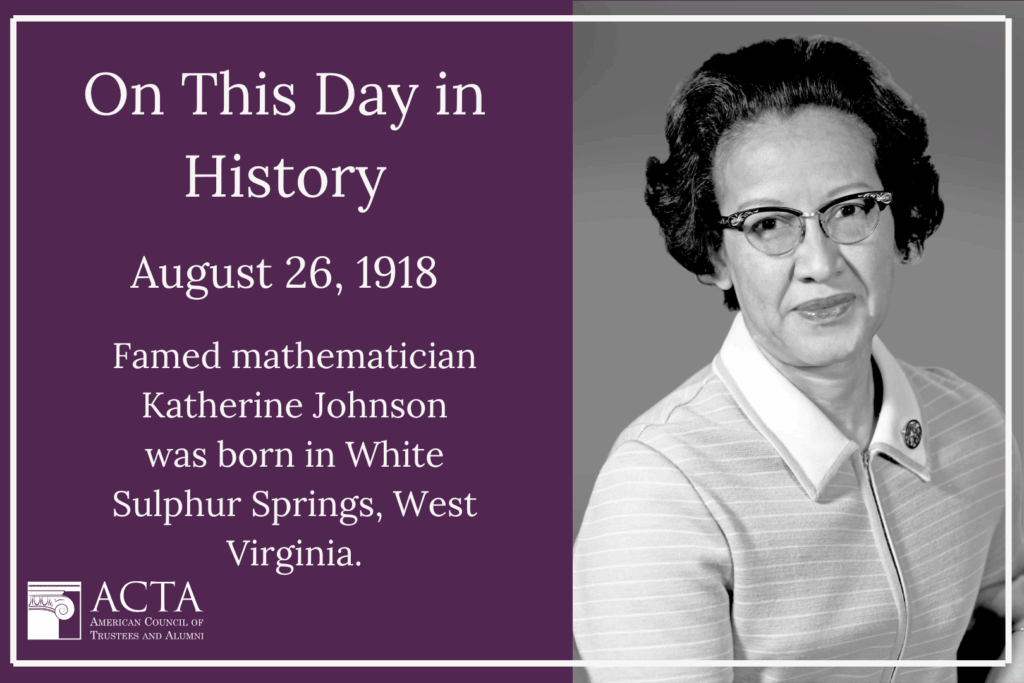
Education is taken for granted in the United States. It is readily available, yet many students pursue their studies half-heartedly. Difficult courses are avoided for easy “As,” with the assumption that most of what’s being taught won’t apply to future careers. However, one of America’s most brilliant mathematicians, Katherine Johnson, thought differently. Born on August 26, 1918, to Native American and Black parents, Johnson experienced segregation that made it extremely difficult to receive more than a grade school education. Despite this obstacle, she attained two college degrees and a stunning 33-year career with NASA. How did she accomplish this? By taking her education seriously.
Fascinated by numbers and words from an early age, Johnson was born with a desire to learn. Her mother started teaching her to read and count in their home in White Sulphur Springs, West Virginia. “I counted everything. I counted the steps to the road, the steps up to church, the number of dishes and silverware I washed . . . anything that could be counted, I did.” Johnson’s hunger for knowledge did not go unseen. “That summer,” she reminisced, “Mrs. Leftwich started a private kindergarten class in her home with me and a few other children, and I officially started school at four years old.” Katherine was a gifted student and excelled in all her studies, especially in mathematics. She finished grade school in just six years, but, unlike many of her classmates, Johnson’s education did not stop there.
Formal education for Black children in White Sulphur Springs effectively ceased in seventh grade, as the nearest segregated school was over 100 miles away. However, these daunting odds did not intimidate Johnson’s parents. “Education was their hope,” she remarked. Like former slave and scientist George Washington Carver, they knew that education was “the key to unlock the golden door of freedom” for their children. So, in September of 1928, Katherine’s father sold his farm and moved his family 122 miles to the West Virginia Collegiate Institute. Here, Johnson and her older siblings were given the opportunity to receive both a high school and college education. Katherine dove into her classes, which included a well-rounded study of mathematics, English, music, geometry, and the natural sciences.
After high school, Johnson joined the Institute’s college program. Although she is principally known for her work as a research mathematician, she nearly passed over the subject in college to major in French instead. Katherine loved the foreign language, and her interest in it heightened during the summer of her freshman year, when she worked as a valet for the Greenbrier Resort in White Sulphur Springs. There, one of the guests discovered she could understand French. “She seemed impressed,” Johnson noted, “and arranged for me to practice speaking French with a Parisian chef in a restaurant at the resort.” Johnson leapt at the offer and decided this was now the focus of her college studies. Her math skills, however, were also not unnoticed. Dr. William Waldron Schieffelin Claytor, a brilliant mathematics professor, saw Katherine’s mathematical potential and convinced her to pursue a double major. Johnson took every math course the Institute offered, with Dr. Claytor creating additional classes just for her. Although she did not realize it, these courses would prepare her for a position with NASA sixteen years later.
Before NASA, Johnson used every aspect of her education to her advantage. After graduation, her French, math, and piano skills secured her multiple teaching positions and the honor of being one of three Black graduate students integrated into West Virginia University. In 1953, Katherine was hired as a “computer” for the West Computing section of the Langley Aeronautical Laboratory. Here, she was charged with manually performing the mathematical calculations needed by its scientists and engineers in the age before advanced computational machines. Johnson thrived in her position. After two weeks, she was promoted to the Flight Research Division, where she remained until 1986. During her career, Katherine performed essential calculations for several of NASA’s greatest achievements, including the trajectory analyses for America’s first human spaceflight, John Glenn’s orbital mission, and the Apollo 11 flight to the moon.
Katherine Johnson never took any aspect of her hard-earned education for granted. She studied every subject with zeal and especially applied herself in several. Each one furthered her career after graduation. Today’s students must take earning a well-rounded education just as seriously. If higher education institutions provide students with the broad base set out by the American Council of Trustees and Alumni’s What Will They Learn?® project, all graduates, like Johnson, will be properly equipped for unexpected opportunities in the workforce.