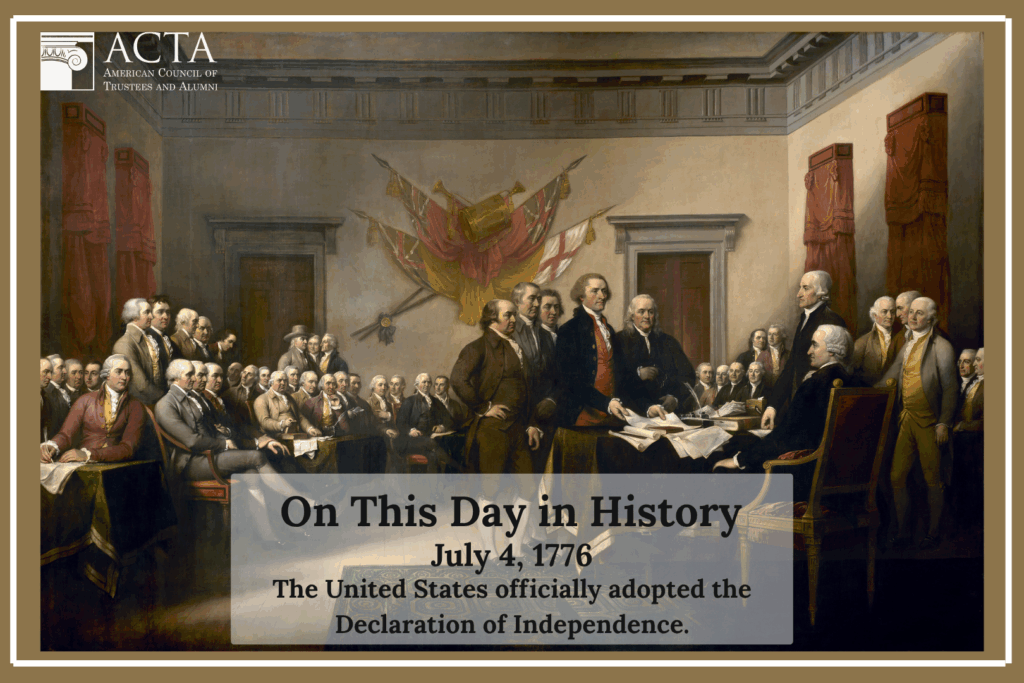
When someone mentions the Fourth of July, images of grand parades, dazzling fireworks, and boisterous gatherings come to mind. Celebration styles have not changed much since 1777, when Philadelphians commemorated their independence with fireworks, parades, and a 13-gun salute fired from ships in the harbor for the 13 colonies. Readings of the Declaration of Independence were held throughout the nation despite the danger from the occupying British forces. Patriotism was aflame, and it refused to be extinguished.
With the nation’s 250th birthday rapidly approaching, one would expect to see the same patriotic enthusiasm today. Sadly, that is not the case. National pride is rapidly fading among the younger generations, and an inadequate civics education might be to blame. Many citizens do not fully understand the gravity of what occurred on July 4, 1776, and why it is a day worth celebrating.
When the War for Independence officially began on April 19, 1775, with the Battles of Lexington and Concord, independence from Great Britain was an unpopular view among colonists. Many wanted the motherland to recognize their rights, including local governance and no taxation without representation. However, anti-British sentiment grew as the British mercilessly attacked coastal towns, and after Thomas Paine argued for a complete separation in his Common Sense in early 1776.
Finally, on June 7, 1776, Richard Henry Lee, a delegate from Virginia, introduced a resolution at the Second Continental Congress saying, “all political connection between [the colonies] and the State of Great Britain is, and ought to be, totally dissolved.” Rather than hastily voting on the motion, the Congress instead appointed a “Committee of Five” to write a document justifying the call for independence. The Committee, which consisted of Thomas Jefferson, Benjamin Franklin, Roger Sherman, Robert Livingston, and John Adams, submitted a formal version drafted by Jefferson on July 1. After serious deliberation, the “Lee Resolution” was adopted on the following day by 12 of the 13 states (New York “abstained courteously”). The Congress then began seriously considering and editing Jefferson’s document. On July 4, 1776, the Declaration of Independence was approved and sent off for publication.
Fifty-six members of the Congress signed their names on the Declaration between 1776 and 1781, a traitorous act punishable by death. Yet the danger did not deter them. While writing his signature, Stephen Hopkins, an older delegate from Rhode Island, stated, “My hand trembles, but my heart does not.” Sadly, many men did suffer for their devotion to liberty. Over a dozen saw their livelihood destroyed, nine died from injuries and trials during
the war, and all were forced to flee their homes to avoid capture. Francis Lewis, a delegate from New York, saw his home and property ransacked and his wife tortured by British soldiers. John Hart of New Jersey died without ever finding his 13 children, who were taken from him during the war.
Unfortunately, few Americans today understand these brave men and the ideals they died for. In a recent survey released by the American Enterprise Institute, only 26% of participants said they had read the whole Declaration of Independence, and only 63% considered it important to teach students the ideas and history that tie Americans together. Sadder still is the current state of patriotism. A 2025 Gallup poll showed that national pride among adults has steadily decreased since 2001, particularly among younger generations.
This decline is due in part to a lack of rigorous civics education in this country. After all, how can someone appreciate what they do not know or understand? The American Council of Trustees and Alumni’s What Will They Learn?® project, which studies the core curricula of colleges nationwide, found that only 19% of institutions require their students to take a course in U.S. government or history. This sobering statistic threatens the “informed patriotism” valued by President Reagan, which cannot exist “unless it’s grounded in thoughtfulness and knowledge.”
As this great nation prepares to celebrate 250 years of freedom, it is the duty of every American to pause and consider the wondrous day that is the Fourth of July. It is much more than a family barbecue or an excuse to fire rockets. On that day, 56 men made the courageous decision to risk everything for liberty, pledging “our Lives, our Fortunes and our sacred Honor.”