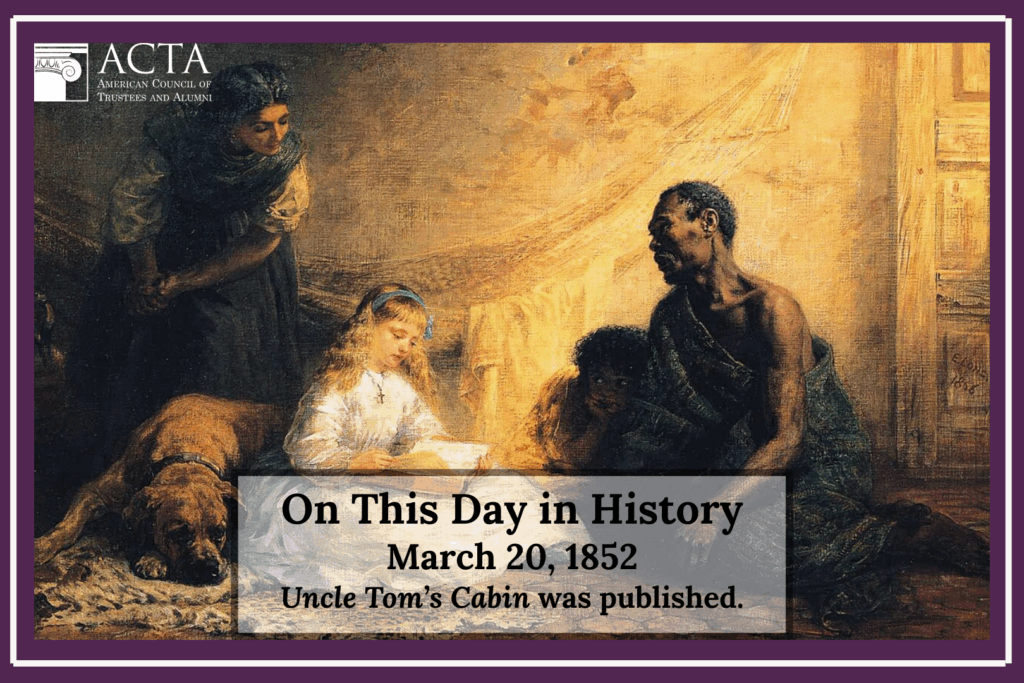
On this day in 1852, Uncle Tom’s Cabin was published. Written by Harriet Beecher Stowe to protest the Fugitive Slave Act of 1850, the novel follows the lives of two slaves, Uncle Tom and Eliza, and the many cruelties they endure at the hands of their owners. Inspired by her faith and equipped with an eloquent voice developed by a rigorous classical education, Ms. Stowe powerfully depicted the inhumane conditions of slavery and sparked new life into the abolitionist movement.
Ms. Stowe was born in Litchfield, Connecticut, on June 14, 1811. At eight years old, she was sent to Litchfield Female Academy, where she studied English, ancient history, geography, arithmetic, and composition. In 1824, she attended Hartford Female Seminary, one of the first classical educational institutions for women in the country. Founded by her older sister Catherine Beecher, the seminary offered an education equal to that of a man’s, including subjects such as rhetoric, Latin, Greek, history, mathematics, and philosophy. Ms. Stowe graduated at 16 and taught composition at Hartford until the age of 21.
In 1832, Ms. Stowe’s father was offered the presidency of Lane Theological Seminary in Cincinnati, Ohio. Moving there with her family, she met and married Calvin Ellis Stowe, a professor at the seminary. Encouraged by her husband, she wrote constantly, publishing several books and crafting countless articles for local journals and newspapers. It was also here that she first encountered slavery.
With only the Ohio River separating her from the Southern state of Kentucky, Stowe frequently encountered fugitive slaves making their northern trek to freedom, and she became an ardent supporter of the abolitionist movement. The suffering endured by slave families affected her strongly after the death of her young son, Samuel Charles, in 1849. She commented, “Having experienced losing someone so close to me, I can sympathize with all the poor, powerless slaves at the unjust auctions.”
When the Fugitive Slave Act passed in 1850, requiring Northern states to return runaway slaves to their owners, Ms. Stowe began drafting what would become Uncle Tom’s Cabin. In a letter to the editor of the National Era,which published the book, she said, “I have always felt that I had no particular call to meddle with this subject, and I dreaded to expose even my own mind to the full force of its exciting power. But I feel now that the time is come when even a woman or a child who can speak a word for freedom and humanity is bound to speak.”
Uncle Tom’s Cabin was an immediate success. In the first year of its publication, 300,000 copies were sold in the U.S., and in Britain alone over a million and a half copies were sold. Critics claimed that the book inaccurately portrayed slavery. In response, Ms. Stowe published A Key to Uncle Tom’s Cabin in 1853, a lengthy bibliography listing sources that backed up the novel’s more controversial claims. Among them were testimonials by former slaves, including Frederick Douglass and abolitionist Josiah Henson who inspired her beloved character, Uncle Tom.
During the Civil War, Ms. Stowe adamantly pushed for emancipation, and in 1862 she was invited to the White House to meet with President Abraham Lincoln. It was here that the president is famously believed to have said, “So you’re the woman who wrote the book that started this great war.” Uncle Tom’s Cabin awakened Northerners to the horrors of slavery and became a flashpoint in the national emancipation debate. Ms. Stowe’s classical education in the arts of composition and rhetoric surely informed her ability to write a novel whose importance endures to this day. As George Harris, a slave who successfully escapes his master, says in the novel, “Give me an education . . . Then I can do all the rest.” Through our What Will They Learn?® project, ACTA advocates for all students to study a well-rounded liberal arts curriculum that will equip them to be the great writers, citizens, and reformers of the next generation.