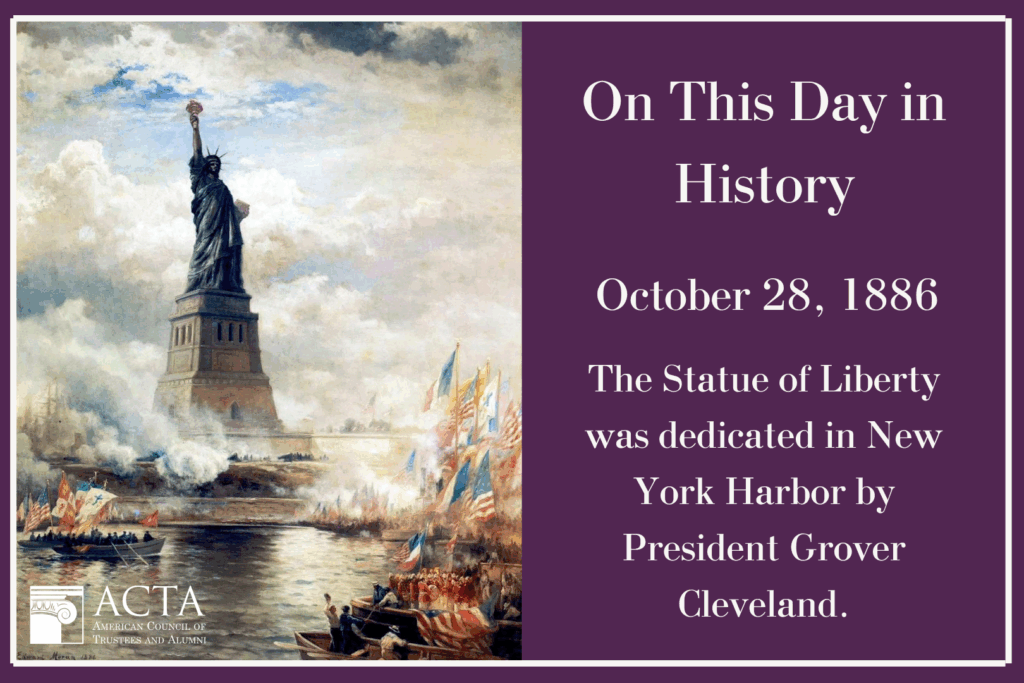
On this day in 1886, President Grover Cleveland dedicated the Statue of Liberty in New York Harbor. Proposed as a gift by French abolitionist Édouard de Laboulaye, the statue was created to celebrate the centennial of America’s independence and to rekindle the Franco-American alliance forged during the American Revolutionary War. However, this “new colossus” was more than just a present. She represented the two nations’ turbulent history: their friendship first united by liberty, and its sudden end when France replaced that common value with political ideologies during its own revolution. The tale embodies the warning in Washington’s Farewell Address against the deadly threat of political factionalism.
Before the War of Independence, the American colonies viewed France with suspicious hostility. The French and Indian War, which had embroiled the land for nine years until 1763, was still in recent memory. However, past grievances were soon forgotten after the Declaration of Independence. The French, inspired by the colonists’ desire for freedom, were eager to weaken their mutual English enemy and agreed to an alliance in 1776. Under the unifying banner of liberty, the two militaries secured several victories, most notably the Battle of Yorktown, which ended the war. By setting aside their differences for a shared purpose, France and America defeated Britain’s superior naval forces. Both countries agreed to retain their partnership after the war, but this new friendship would soon be tested.
On July 14, 1789, French supporters of the National Assembly stormed the Bastille, killing the garrison’s commander and several permanent officers. Despite this violence, many in the States applauded the French Revolution. They wanted the nation to follow in their footsteps and form another country dedicated to “life, liberty, and the pursuit of happiness.” However, as the bloodshed increased, including King Louis XVI’s execution, American support wavered. Unlike in the War of Independence, the original, unifying purpose of the French Revolution was forgotten. The numerous political factions were only focused on outdoing each other. Divided against herself, France quickly succumbed to chaos. President Washington, wary of embroiling his country in another war, issued the Proclamation of Neutrality. It announced that the United States would remain neutral in foreign affairs and declined to send aid to France. The friendship once united by liberty was severed, and without internal stability, the French Revolution merely paved the way for Napoleon’s eventual dictatorship.
Washington, likely inspired by developments in France, warned in his Farewell Address against “the batteries of internal and external enemies” that would seek to destroy the United States. Among the internal threats, he named political factions as particularly dangerous. Washington urged the people not to dwell on petty differences, but on the commonality they all shared as Americans. “The name of American, which belongs to you . . . must always exalt the just pride of patriotism more than any appellation derived from local discriminations. . . . The independence and liberty you possess are the work of joint councils and joint efforts—of common dangers, sufferings, and successes.” Only by focusing on their shared status as countrymen and by valuing freedom above fleeting political opinions could the people of the United States avoid France’s fate. Washington’s words told a simple truth, and that truth inspired the French abolitionist and U.S. Constitution expert Édouard de Laboulaye nearly a century later.
By 1865, France had already endured five political regimes. Now, during the Second French Empire, the people were again divided. Some favored a monarchical system, while others, including Édouard de Laboulaye, yearned for democracy. However, unlike some contemporaries, he believed liberty must be achieved lawfully and peacefully, not through violence. He proposed giving America a sculpture, Liberty Enlightening the World, to commemorate the centennial celebration of its independence. With the statue, Laboulaye desired to restore the Franco-American friendship and remind France that freedom was the natural order and right of all peoples. Hundreds from both countries attended its dedication ceremony on Bedloe’s Island. Liberty had once again united the two nations.
The history represented by the Statue of Liberty contains a twofold message. It shows that individuals united by common moral values can produce lasting achievements. However, like Washington, it warns how easily such triumphs are undone through internal division. In this polarized age, Americans must not place political differences ahead of their mutual freedom. Otherwise, the United States will follow France’s tragic example and lose its liberty in self-destruction.