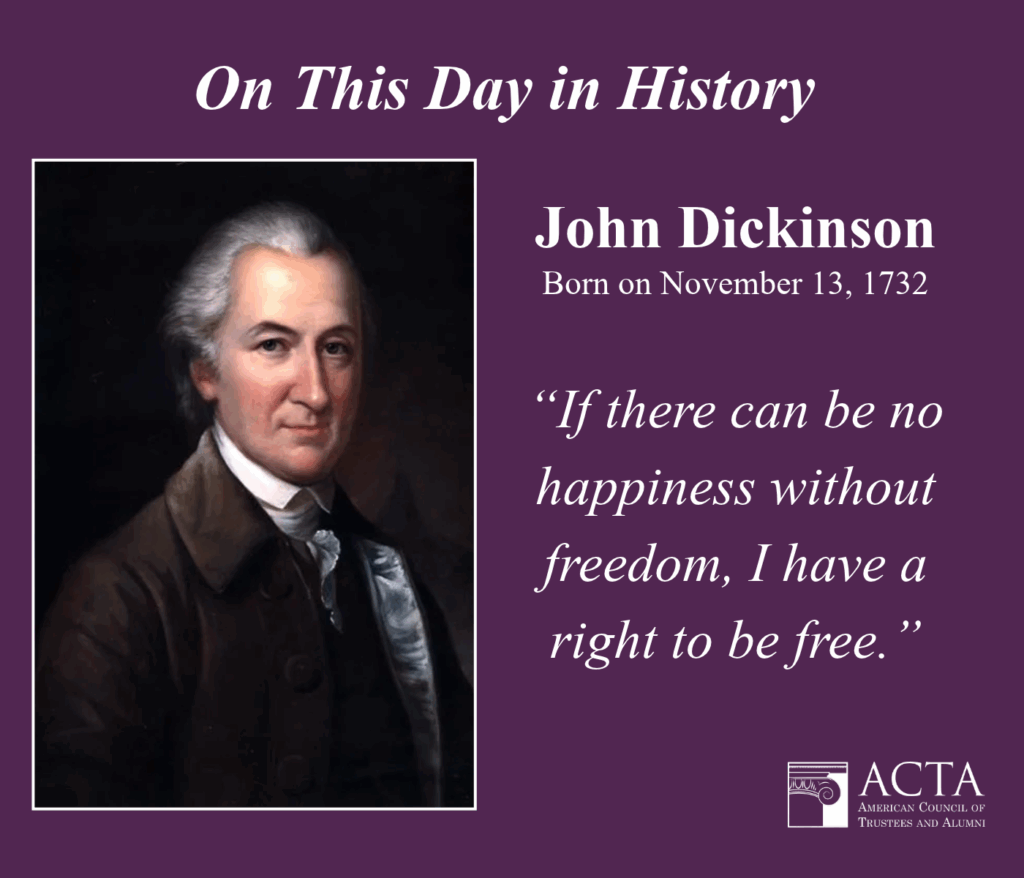
In November of 1732, Founding Father John Dickinson was born in Talbot County, Maryland. A learned statesman and lawyer, he served in the militia during the Revolutionary War, was the principal writer of the Articles of Confederation, and ardently supported the U.S. Constitution. Dickinson was also a fervent abolitionist and proponent of the just and equal treatment of all Americans, including slaves, women, and Native Americans. Sadly, because of his misunderstood refusal to sign the Declaration of Independence, many view Dickinson with little regard or even outright contempt. However, Dickinson should be highly honored because his life’s actions prove that he was a true patriot and protector of freedom.
Much of the unjust criticism of Dickinson originated from another, more vocal, Founding Father: John Adams. “A certain great Fortune and piddling Genius whose Fame has been trumpeted so loudly, has given a silly Cast to our whole Doings.” Written in 1775, this unfair statement expressed Adams’s frustration at Dickinson’s opposition to colonial independence. However, contrary to his inaccurate portrayal in the popular 1776 film, Dickinson was not entirely against independence. According to Jane Calvert, historian, author, and founder of the John Dickinson Writings Project, “He was the first person to imagine a distinctly American identity and American civil society.”
Nevertheless, Dickinson was a rational, level-headed man. At the time, the colonies had no organized militia, no foreign allies, and no immediate structure with which to govern themselves. Dickinson worried that the colonies were rushing unprepared into a major conflict and therefore urged reconciliation before beginning a revolution. Despite his efforts, the Continental Congress adopted the Declaration of Independence on July 4, 1776. Although he refused to sign the document, once the conflict began, he joined the American military and afterward served in the Continental Congress until 1781. When asked why he chose to fight for the revolution he tried to prevent, he said he “was resolved to share, and to stand or fall with her [America] in that plan of freedom which she had chosen.”
While the War for Independence ended in 1783, Dickinson’s fight for freedom continued. Recognizing that all human beings had fundamental rights, the Founding Father wanted every American to share in their country’s newfound freedom. In 1780, he helped pass one of the first laws against slavery in Pennsylvania and tried to include an anti-slavery clause in the initial draft of the Articles of Confederation. Calvert notes, “By 1786, he became the only founder to free all of his slaves during his lifetime.” Dickinson also strove to protect the rights of Native Americans. According to Calvert, he “sought property rights, dignified treatment, and protection from Americans’ rapacious land acquisition.” Additionally, Dickinson defended freedom of speech and religious liberty for women and sought to provide all children, including Blacks, with a thorough education.
Although he is ridiculed for not signing the Declaration of Independence, John Dickinson was a true defender of freedom. Not only did he fight as a soldier during the Revolutionary War, but he also passionately advocated for the equal treatment of all inhabitants of the new country, including slaves, women, and Native Americans. His actions prove his unwavering loyalty to America’s founding principles and to “life, liberty, and the pursuit of happiness” for all her citizens.