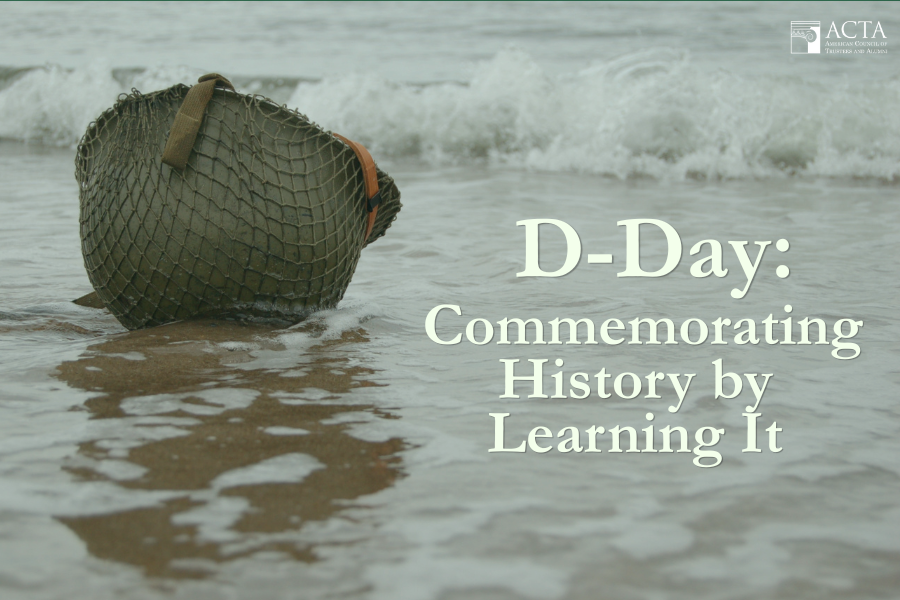
Eighty-two years ago, on June 6, 1944, the Allied Expeditionary Forces of World War II stormed the beaches of Normandy, France, in what would be “the largest amphibious invasion in military history.” Known as Operation Overlord, or D-Day, the invasion was the opening act to a colossal campaign to liberate Europe from Nazi Germany. It involved thousands of naval personnel, airmen, and ground troops from multiple nations, including America and Great Britain. Casualties reached 10,300 during the landing. By the end of June, the operation successfully delivered over 850,000 personnel, 148,000 vehicles, and 570,000 tons of equipment to Normandy. Almost a year later, in May 1945, Germany surrendered.
In the years following, Americans have commemorated D-Day formally through memorials, speeches, and film. Even with all the “pomp and circumstance,” though, there is reason to suspect that few Americans fully know or understand the period. For the 70th anniversary of D-Day, in 2014, the American Council of Trustees and Alumni (ACTA) conducted a survey to assess Americans’ knowledge of that historic day. The findings were quite telling:
- Only 54 percent of respondents (including college graduates) identified Dwight Eisenhower as the supreme commander of the Allied Forces
- Less than half of respondents knew that Franklin D. Roosevelt was the president then
- 15 percent (including one in 10 college graduates) believed the D-Day invasion happened at Pearl Harbor
“What we have here is a tragic case of historical amnesia that is not only dangerous for America’s future, but also a slap in the face for all those who fought so valiantly for America’s freedoms,” said Anne Neal, then ACTA president and current member of ACTA’s National Commission on American History and Civic Education. Based on ACTA’s more recent 2024 survey assessing college students’ general knowledge of American history and government, with equally glaring results, it is unlikely that the situation has improved.
Of course, commemorative moments such as President Ronald Reagan’s renowned “Boys of Pointe du Hoc” speech (1984) and popular culture artifacts like Saving Private Ryan (1998), Band of Brothers (2001), and Pressure (2026) can help us remember and appreciate the sacrifice and magnitude of the day. However, they cannot substitute for the serious study of the period and its implications for our nation and the world. As President Joe Biden stated at the 80th anniversary of D-Day in 2024:
We must remember that the fact that they [Allied Forces] were heroes here [Normandy] that day does not absolve us of what we have to do today. Democracy is never guaranteed. Every generation must preserve it, defend it and fight for it. That’s the test of the ages.
Two years later, we have the special opportunity to commemorate the 82nd anniversary of D-Day at the same time we celebrate America’s 250th anniversary. What better tribute could there be to “the boys of Point du Hoc”—and all the brave souls who have ever given “the last full measure of devotion” fighting for freedom at home and abroad—than to recommit ourselves to a deep and serious study of our nation’s history! Such a pursuit, though not as life-threatening as storming a beach in wartime, is no less consequential to the future of a free people.
“Strengthened by their courage, heartened by their valor, and borne by their memory, let us continue to stand for the ideals for which they lived and died.” -President Ronald Reagan, June 6, 1984