Elevating Student Learning through Civil Debate and Dialogue: Dr. Melanie Escue
By Dr. William Bryan Paul, CD&D Curricular Fellow
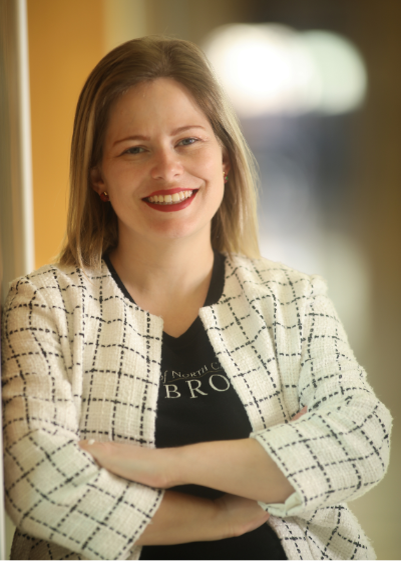
With generous support from the Barnes Family Foundation, ACTA’s College Debates and Discourse (CD&D) Alliance has brought immersive civil discourse programming to all 16 public institutions in the University of North Carolina (UNC) System. At the heart of this statewide initiative is a fellowship model that charges faculty and student leaders with fostering communities of civil discourse practice that promote free expression, viewpoint diversity, mutual understanding, and solutions-oriented conversations. UNC faculty fellows (like other CD&D fellows) are hired specifically to organize classroom debates/dialogues and support student fellows in campuswide programming. While each faculty fellow brings something special to this work, one in particular has exceeded expectations.
Dr. Melanie Escue, Assistant Professor in the Department of Sociology and Criminal Justice at the University of North Carolina Pembroke (UNCP), is the archetypal faculty partner. Her contagious enthusiasm for this work is hard to miss. Since starting as CD&D’s UNCP Lee Barnes Campus Debate Faculty Fellow in Fall 2024, she has gone beyond her job description to mentor student fellows, galvanize attendance at campus debates/dialogues, host a training workshop, and collaborate with other faculty to spearhead 30 classroom debates/dialogues—with 18 classroom activities planned for Fall 2026 alone! (For context, a CD&D faculty fellow needs to hold at least one classroom debate or dialogue per semester. You do the math.)
And that’s not all. In January 2026, she represented CD&D at a UNC Board of Governors meeting, reporting on the impact of our programming at UNCP and across the UNC System. Her presentation solicited high praise from Board members and other public attendees. She went on to represent CD&D at the UNC Common Ground Collaborative Convening in May 2026 and even broke ground for CD&D in South Carolina at Francis Marion University in September 2026.
From the classroom to the boardroom, Dr. Escue has been a tireless ambassador of civil discourse, demonstrating that this work means more to her than just another line on the CV. What drives her extraordinary efforts on and off campus? I spoke with her to learn more.
What inspired you to become a university professor?
Well, that’s a huge question. I think we change what we want to do throughout our lives. My very first major was investigative journalism—I like researching and writing. And then I landed in psychology, which was really interesting and exciting. A lot of forensic psychology with statistics and research. I really liked research, and I thought this would be really cool—I could go to grad school for this and become a professor. So I went to grad school for criminal justice, and I think it just was on that trajectory that I always wanted to teach in some way.
It is a space where you can freely explore ideas and everybody has the responsibility to be respectful of those ideas, whether they agree or not.
At the time, you don’t really know about tenure track. It’s not something you’re necessarily thinking about. You’re thinking, oh, I’d love to be in the classroom in college. I think that’s probably what I thought. And then you become a teaching assistant and you get a little more experience. And then heading into the PhD, I mean, there are only two pathways, academic or non-academic. And the tenure track was definitely the goal for me because you do it all. You do research, you do teaching. And it’s like this career that you can build and it’s really customizable. It’s like a create-your-own-journey. That was really exciting to me. Applied work perhaps would pay more. It definitely would, which is interesting. But then people kind of own the rights to everything you do, right? Like you do research, they publish it. You do this, it’s theirs, right? So the autonomy wasn’t there. But being a tenure-track faculty member, I mean, we have to do service and research and teaching, but we can do it the way we want to. We can teach the classes we want to. We can research what we want to. We can do service in the ways we want to. So it’s cool because it also allows us to grow and change, right? I mean, what you research year one won’t necessarily be what you research year 10. So it’s cool. It’s really flexible.
And I think that’s also why I love CD&D debates because I can do them across 30 different disciplines and you learn something new about each discipline in the process. You have to do a little research in advance. Okay, what are they debating? How are they going to do that? What would be the best way to assess a computer science debate versus a business debate versus a political science debate? What matters in these disciplines? So you start to become very interdisciplinary at your core too, because you’re learning about all these other areas, which is really cool to me.
It is really interesting because over half of my work is done outside of my field. There are different ways to think about it, right? I mean, you could say interdisciplinary, but you could also just say that being a researcher, a scientist, you are just at your core interdisciplinary. I do surveys and interviews. I can do that for anything. It’s adaptable and moldable. I don’t have to be fixed in one area. So it is really cool.
I think that’s what got me to the point. You feel like you have a job and you work all the time, but I think that’s the running joke, right? It’s so flexible that you work 24/7. Not like a “9 to 5.” But I think people who do it . . . that is who they are. We like that. We’d be bored otherwise.
How would you describe the state of U.S. higher education today?
Thinking about higher education in the country today is very concerning. I’ve noticed a lot of censorship across college campuses. I’ve noticed that a lot of students, staff, and faculty feel like they can’t share their authentic perspectives on issues, which really blocks the ability for growth. If we can’t engage in discourse, if we can’t talk about social topics and we can’t engage in things that are important in our lives on college campuses, then it begs the question of where can we have those conversations?
Oftentimes we also shut down those important conversations around challenging issues, whether we’re in support or not. And so that’s for me, I think, the biggest concern: we’re not engaging in those authentic dialogues anymore.
Higher education is so critical. I think, sadly, most people reduce higher education to a degree. You know, you come in, you get your college degree and you leave, but it is so much more than that. Because even in jobs, even in the workforce today, everybody’s got the degree, right? But what are you going to do to set yourself apart? That’s all the skills you learn in higher education, right? Critical thinking, learning viewpoint diversity, being able to engage with others. Look at all the skill sets that are preferred or required in these jobs you’re applying to. It’s far beyond the educational component. So I think diluting higher education down to just getting a degree does a vast disservice to what we do. And it’s a misrepresentation, right? We provide a space for students to grow. We provide a bridge between home and their own independent life. So they graduate high school, they come to college; but this is not just a stopping point. This is a transitional period, a critical transitional juncture, especially for our young adults who are transitioning from high school to living with their families, to transitioning out on their own one day, having families and whatnot, right? So being in college provides them the experiences and opportunities to develop into a socially informed citizen. It gives them the critical skills to live on their own one day. It provides things that nobody else can give them because this is what we’re here to do. And beyond that, it invests in them. We help them believe they can be whatever they want to be. And the job can’t do that. You have to have that before you get to the job. And so I think the attacks on higher education really come from an ignorance about what it is and what it’s capable of because we are a vehicle for change and sometimes that’s threatening.
I’ve noticed that a lot of students, staff, and faculty feel like they can’t share their authentic perspectives on issues, which really blocks the ability for growth.
I think here at UNCP, we cater to a very specific population of students. A lot of our students are raised in very rural, economically deprived areas in North Carolina, and they’re taught to graduate high school and then go to college. And so if they do make it to college, then they sort of just get their degree and want to get out. And so that opportunity and also just the encouragement to explore their own perspectives is very limited here. And there are some great discussions I’ve had in class with students, but outside of that, most of them will come up to me and say, this is the first time I’ve ever been able to express my perspective. I think it really speaks to a cultural expectation that you just don’t speak your mind and you keep your head down and move forward. And I think that’s very dangerous when we’re trying to raise the next generation of leaders here, that they just don’t feel like they’re able to speak up.
What led you to become a CD&D Lee Barnes Campus Debate Faculty Fellow?
I was contacted by CD&D Program Manager Kayla Johnston in Spring 2024, because a student of mine had referred me to be the faculty fellow here on campus. I still remember the e-mail, just all the energy and enthusiasm Kayla had, and I’d always valued the opportunity to bring debates and deliberative dialogues into my own classroom. I didn’t use the CD&D methodology at the time, but this seemed like such an amazing opportunity to bring this pedagogy into my classroom and also share across campus. And so when I was asked if I’d be interested, we had a few conversations, and then I was invited to the Braver Angels Convention in June 2024. And that was just such a life-changing experience. It was so exciting to be in a space where people didn’t feel like they had to be censored. They felt like they could explore their ideas and say what they thought. You could also see a lot of transformation happening, and that’s the goal for me in my classroom: to challenge my students to think beyond their own perspectives and to, what I call, divorce people from perspective. In other words, we don’t place blame on people for their thoughts, but we want to seek and understand why they think the way they do.
We saw that there was a great response to having these debates on campus. Students weren’t like, I just was always wanting this. It was more like, I didn’t realize what I was missing out on.
It’s incredibly important. I think if you want to be a social scientist, as I strive to be, and an advocate in the community, you have to know your community. And so if I’m here in, let’s say, the Pembroke and Robeson County community, I need to understand people’s life journeys. And it’s going to be different than my life journey because I didn’t grow up here. And so you cannot tie emotions to people because people believe what their life experiences have taught them, which also gives us hope that they can be changed. Those perspectives can be adjusted and adapted. And so it’s about growing together despite our differences. And so I think through that Convention experience, it really showed me there’s just so much potential even beyond the classroom. And so I was really excited to get started.
So I started as the faculty fellow at UNC Pembroke in August 2024. And we had one student fellow, Kai Anderson, who was simply amazing. We worked closely together and launched two in-class debates in the fall. Kayla Johnston came down and helped with those as well. I think through the fall we saw that there was a great response to having these debates on campus. It’s sort of like that saying, you never know you needed it until you didn’t have it, right? Students weren’t like, I just was always wanting this. It was more like, I didn’t realize what I was missing out on. And that was really cool. And that really speaks to this community not feeling like they can voice their perspectives.
How would you describe CD&D programming?
Participating in these events is really unlike a traditional debate. When you think of debate, you think there’s going to be a winner and a loser, and we just don’t have that. And that’s a good thing because nobody knows enough to win or lose! These sorts of topics are just so multifaceted that no single individual can have the answer. And that’s the point: to engage in dialogue. And so what I experience is that it’s really a conversation. Even if we label it as a debate, it really isn’t.
And I think even the setup of the room—it is set up in a way that isn’t divisive. It isn’t like sit on one side or the other, because we’re all in this conversation together despite our differing life experiences that bring us to the viewpoints we have today. And so I think for me, just the initial setup and the climate really sets the stage for an event that’s going to bring people together and not drive us apart. And so that’s really important to me.
The second thing I think that really sets these apart is the role of the debate Chair. The Chair comes in and, from the beginning, sets the tone for how to respond if someone says something that you like or don’t like, using “snaps, pats, and taps.” There is no yelling, and there’s no belittling of others who may have different views. Even if you don’t agree with something, there’s still a high level of respect that is expected. So there’s no prioritization of one viewpoint or another. It is a space where you can freely explore ideas and everybody has the responsibility to be respectful of those ideas, whether they agree or not.
And I think another critical point of these debates is that they are models of learning. We set a resolution and invite opening speakers to share their perspective within a few minutes. The chair really keeps everyone within their time. While they’re speaking, everyone is expected to listen and learn. I think listening is more of the goal of these than even talking, and I think that’s really important because we live in a culture of wanting to always have the first and last word. Being in this space forces you to really think before you speak, and that helps participants actually grow. You can’t really grow when you’re talking because you’re not listening, right? So it does seem kind of silly, but it works. We all have these ideas about all these topics, but we just need to listen because that’s how we learn. And I think that really, really helps and shows this programming to be something very unique.
What are the highlights of being a CD&D faculty fellow?
We have a lot of great guidance from the national CD&D team, which is great. You have the whole team that’s there to support you. I think that’s really been a highlight is just going, hey, I have these classroom debates, but I don’t really want to chair them myself, and then someone from the national team will come down and chair them. So having that, I think, is really important. It’s very much a team initiative. And that is important, right? It’s important to have a lot of hands on deck.
I definitely see classrooms as spaces for the engagement of diverse viewpoints. I think that in a college class of any content area, you have to allow room for people to have disagreement.
At the same time, I think that what I really like is there’s autonomy. There’s heavier guidance at the beginning because we’ve got to learn the ropes, right? I’ve got to know what the CD&D Curricular Toolkit is. I’ve got to know how to run the debates and dialogues. Clearly, I don’t know right off the bat, but then the reins loosen and we kind of just curate it for our campus. So I like it that there’s flexible oversight. If we need guidance, if we need support, we reach out. But if not, then we have that autonomy to implement the programming on our campus. So I think that’s important, too, that it’s not rigid like some organizations. I can be flexible in my pedagogy. I can have room to play with some ideas or adapt things in different ways. You can use the Toolkit to adapt the programming however you see fit, which makes it malleable for different campuses, disciplines, departments. I think it’s what makes it multidisciplinary because if it had a rigid rubric, it’d be harder to implement in other disciplines.
So that’s what I like about it. There’s oversight, there’s great collaboration and camaraderie, but there’s also a lot of room and encouragement and support for us to develop our own campus identity.
How does this programming align with your own teaching philosophy?
I definitely see classrooms as spaces for the engagement of diverse viewpoints. I think that in a college class of any content area you have to allow room for people to have disagreement. I believe that any class you teach, you should create space and be intentional about creating space and activities that do engage diverse viewpoints, not just one viewpoint or my viewpoint. I don’t ever say what I think personally in my classes. I think CD&D programming enhances my teaching because of the tools it offers. What the programming does is it gives faculty rubrics, assignment templates, and instructions for how to run debates and dialogues in your class and how to assess them in a rigorous and systematic way. I think it gives us measurable metrics that help us move our teaching philosophy to practice. The CD&D Curricular Toolkit helps us do that in our classes.
What have you witnessed as far as a transformative experience in this work?
I’ll speak to the in-class debate I held back in Fall 2024. I was working with a social problems class. It was about 45 students, and nearly all of them were under the age of 20. Most were first semester freshmen, so young, and I think just kind of getting out there. Most still lived at home or at least on campus. There wasn’t a whole bunch of independence there, and that’s important because you could tell that they really hadn’t developed the courage to have independence of thought. Oftentimes our own personal independence is linked to how and why we think the way we do, right? So when I proposed holding a debate as part of the class, a few actually expressed to me that they had never been asked what they thought. Public school systems encourage memorization and regurgitation. They encourage reading and then circling on the multiple choice test and going, what did you read, right? But there’s no critical inquiry. There’s no, well, what did you think about it? So the minute students are asked what they think, they don’t know what they think because they’ve never had time to sit in that thought. And so when I realized that, I actually built the debate in as 10% of their grades. I sort of removed other assignments. They met the same course expectations and goals, but this felt more important. And it felt more important because if I could have at least one student leave this class feeling like they did have a perspective and they could use that voice and go on to do really transformative things, it was going to be worth the time.
Also, instead of having them just talk during the debate, we had multiple research sessions before that. I had them look up the topic, which was whether the government should control gun usage and ownership among citizens. Most of them didn’t really know state or federal gun laws, so how were they going to have a debate if they didn’t know much about the topic? And I still remember them asking me, why don’t you just tell us? Like, what is the answer? And I’m like, no, I’m not going to tell you. You need to look it up. You need to open your laptop and find out. We kind of stared at each other for a few moments, and they were just waiting for me to cave and just tell them the answer. When they saw I wasn’t going do that, they were like, Okay, and then they did it.
When they looked it up, you could just see the wheels start turning, going wow, I never realized this was the law or this was the rule. And that made us start thinking, well, why? What’s behind this, right? And so what was awesome is after that one research session, I actually had six volunteers to be opening speakers: three in the Affirmative and three in the Negative. We then worked together over a period of two weeks developing their opening speeches. They were in charge of their perspectives, and then they would share in small groups to receive feedback before the debate, so they gained more courage and more experience. And they also heard what others were thinking, both in the Affirmative and in the Negative, and they found that very interesting.
I think the transformation was that they came to know they could do this. They came to know that their voice did matter even if they weren’t like a lawmaker or like a 50-year-old that has been around, right? They could still have a voice at 17, 18, 19. And so that was really, really transformative. And while we only had one debate built into the course, it was so transformative and they loved it so much that we did another one.
Why should other faculty consider holding a debate or dialogue in their own classes?
CD&D programming is probably one of the most powerful pedagogical tools at our fingertips right now. It’s a social action we can all do. We might not be able to transform policies right away, but it’s something that we can use to inspire and to create active engagement in our classes. And I think that’s what faculty right now, from what I’m hearing, desperately need. We need ways to engage our students. They’re lost in social media. They’re lost in the next thing. They live in a society of immediate gratification. And debates require them to work a little bit, but it also provides them with these incredible skills that are going to become invaluable in the marketplace, whatever marketplace.
This programming is a tool for getting students motivated and keeping them engaged. When you get a group of faculty together, we’re usually lamenting about AI or how students are very discouraged and unmotivated and unfazed by what we talk about in the classroom. They could care less. They’re on their phones, their tablets, right? So oftentimes, whenever you talk to faculty, that’s really where the conversation goes. To that, I’ll say, well, have you thought about engaging students in this way? I’ll present the idea and consider with them how this could work for their classes to get students more engaged. I don’t say, oh, you should do this in your class. What I’ll usually do is go, well, hey, I’m having a debate on this day and time. You should come. So I’ll invite them. That’s how I’ve gotten a few different people to come to do their own debate. So I’ll invite them to my debate and then they’ll see how it’s run, which is so much better than just telling them how it’s run. And then if they’re interested, we connect and we really design something for their class.
I think what’s amazing about this [CD&D] initiative is that it’s not discipline-specific, so any single classroom can use this, from biology to nursing to chemistry to business to. sociology, criminal justice, and across the board. Administrators could use this as an icebreaker in their meetings. We could do it in faculty meetings. I think the opportunities are limitless for the potential for this to be very transformative. And I think creating a culture of embracing differences is something that really could enhance the experience for college students, instead of just living in their silos with people that believe just like they do. It’s important for us to coexist with others that might not believe the same because that will make us successful beyond college.
What does a community of civil discourse practice at UNCP look like to you?
I think there’s a lot of potential to make a community of practice at UNCP. I’ve had overall really positive responses from faculty across campus and across disciplines, from the social sciences to the STEM fields. At our 2024 faculty training workshop, we had participants that represented a variety of different colleges and departments, including the College of Business, the Department of Mathematics and Computer Science, Political Science, the Dean of the Library, as well as other members of our campus community. And so I think that shows us that this is not a discipline-specific endeavor. It’s not just for sociologists, it’s not just for criminologists, it’s not just for political scientists. This can turn into a shared initiative amongst all faculty and create an interdisciplinary collaboration to bringing and keeping civil debates and dialogues here at UNCP.
I think just from what we’re seeing, I think the way we turn this into an individual endeavor to a community of practice is by teaching faculty how to use this in their own classrooms. And so again, it would be creating a team, right? So it’s going to take more than me. It’s going to take a group of faculty that want to bring this and keep this here. And the step we took at the workshop was the first step to creating that.
How supportive has your administration been of this work?
I have had no resistance to this work here. From the beginning, I was very open about my role as a faculty fellow. I’ve had meetings with different administrators explaining my position and the beliefs of the organization, emphasizing that it didn’t prioritize one side or the other. And I think that right there was really important, so they are very much in support of embracing viewpoint diversity. They’re very much in support of bringing these kinds of discussions to campus because they want to hear from students, they want to hear from faculty, they want to hear from staff. Our 2024 training workshop was funded literally by the provost! And so we do have administrative support. They authentically like it because it’s bringing people together and not dividing us.
Why does this work matter?
Civil discourse itself used to be right at the cornerstone of higher education. We have become more polarized as a society over time. It never used to be that way, but now it is. And the gaps are wider. And college students are, I would argue, probably one of the most impressionable groups of students. This is the audience. This is the captive audience for politics, right? We want people to vote. What group are you going to focus on? You’re going to focus on college students. And college students at the same time are often the most uninformed because they tend to still think how their parents think or what they see on social media or what they see in the news, and they don’t hold their own viewpoints often. So this is the group that is most at need. They are at voting age. They are in this age where their voice really does make a difference versus maybe somebody who’s a little bit younger, who’s still getting their bearings and figuring things out. For college students, this is literally the place where it has to happen because if it doesn’t happen and people don’t learn to disagree respectfully, and students don’t learn to get their voice heard without yelling or fighting, and then they leave, they go out in the world and then it’s like there is no pulling them back because at that point their identities are formulated 25 and over. I mean, they are sort of fixed and that is what happens to people. And then they get their first job and they have to work with people who don’t look like them, don’t have the same background as them, don’t have the same beliefs as them, perhaps diametrically opposed to them. And they have no toolkit. They have no skill set in order to navigate that situation. So they face challenges.
CD&D programming is probably one of the most powerful pedagogical tools at our fingertips right now. It’s a social action we can all do. We might not be able to transform policies right away, but it’s something that we can use to inspire and to create active engagement in our classes.
Similarly, relationships, maybe having their first serious relationship post college, having kids, starting their life, learning all the different things, right? But if they don’t have this toolkit of learning to navigate contentious conversations and learning to think through all sides of every argument, they will struggle and suffer in every part of their life. But in college, it really is a concentrated space where you have them. And faculty hold a really important position. And our position is not just about grading. We can really shape and mold students. Now that can be good and it can be bad, right? It can be good because if you create that space for exploration and for competence building and for sharing of ideas, it’s great, right? You’re doing something really important for them. But at the same time, we also hold the power to do something really not so great, like perhaps sharing our personal viewpoints and not allowing space for competing ideas or maybe even dismissing them altogether from our students because we are the experts in our field.
We hold this power, and it’s a lot of power. It’s far beyond grades. I mean, grades are important, but students respect faculty. They look up to them. Some of them want to be faculty, and so they want to impress us, right? That’s why doing this work in college is so critical because it is the one time in the lifetime trajectory where students have to be in a class away from home. They’re not in high school, so they’re not going home to mom and dad necessarily. They have to be here, right? And they’re taking classes. And those classes are molding the ways they interact outside of classes and then outside of school. And then when they graduate and get married and have kids and do all these different things where you have to learn how to be a little uncomfortable, you have to learn what to do when you lost all your money, you lost all your job, and now you’re evicted and you’re out straight. I mean, things happen. That’s real life, right? And hopefully it doesn’t happen to everyone, but it happens to people. And sometimes you wonder if those people had these skill sets, had this ability to articulate ideas, to engage in contentious conversations, could their life have turned out differently? Potentially. It can’t solve everything, but civil discourse is not like learning how to debate nicely. It’s about learning how to live successfully. That’s the way I view it. So that’s why college is the perfect place to do this. It is really the place. I think it’s the only time, really.
Let me tell you, though, it is important, even for us. I mean, not just for our students, but I think for us as debate Chairs and dialogue moderators, right? The more you chair debates, the more you put yourself in situations where you face disagreement. And the more you do it and are tooled in this way, you become stronger, you become better, you become more critical, you become more inclusive. It changes you in the same process, which is really important.
I think it helps us depolarize ourselves. Who we are as faculty is going to be different from who we were as incoming college students. And even the things we research, maybe we’ll look back and be like, I was not very open to other perspectives, because that’s the way we’re trained, right? As social scientists, we are trained in niche areas. We’re trained by niche people where you follow along with what they want to do. The research they do, you do it, right? And you’re kind of echoing what they’re doing. But doing this work, it helps you—it gives you permission as a faculty member to go, I don’t have to be embedded in these ideas. It’s okay for me to even change what I think, and that’s hard to do in academia. You don’t have to pick a side, which can make it really confusing for people because we’re kind of pushed into sides, but you don’t have to. So it kind of gives you permission to be free in a lot of ways from that politicization of academia.
So I think it’s not only important for our students, but it’s more for us as faculty, whatever discipline we’re in, to do this work because it helps us depoliticize ourselves. Whether we want to admit it or not, we hold beliefs and we’re not always flexible. I think that it’s cool because it kind of makes you an enigma in a way. People can’t figure you out because they don’t know what you think. So it is interesting. It’s like a mystery, right? But I think that’s important because if you knew what the debate chair thought, you’d still be trying to speak to that. It’s not that you’re devoid of perception; of course we have our own thoughts. But it’s learning how to filter that. As chair, you give participants space so they can come up with an informed position. It doesn’t matter what the position is as long as it’s informed. That’s it. It’s people, not perspective, right? Divorcing people from perspective.
Any advice for students?
The one thing students should always remember is it’s not about what you think, it’s about why you think it. And so if we move beyond the what, if we move beyond whom people vote for or what people believe, or maybe what people don’t believe to understand why they believe the things that they do, that’s how we make real change. You have to understand the why behind it because it really doesn’t matter what you believe. I always tell my students, I don’t care what you believe. I care why you believe it. It means little to know what somebody believes. It means very, very little. It means nothing, almost, because unless you tell me why you believe it, then you’ve left me nowhere. I don’t know what that means. So think about that. The next time you’re around someone who might not have the same viewpoint as you, who might not have the same life journey as you, who might have voted for the candidate you didn’t vote for, let’s say, try not to judge or blame and try to think why would they do that. Why would they vote for that person? What in their life has led them there? And when you can tap into the why, you can engage in a meaningful conversation, and who knows, right? Who knows what can happen from there!
Like Dr. Escue, you can elevate student learning and engagement using the CD&D Curricular Toolkit.
Questions? Contact CD&D Curricular Fellow Dr. Bryan Paul at wbpaul@goacta.org.
Read more about UNCP’s community of civil discourse practice here.
WHO WE ARE
Launched in 1995, we are the only organization that works with alumni, donors, trustees, and education leaders across the United States to support liberal arts education, uphold high academic standards, safeguard the free exchange of ideas on campus, and ensure that the next generation receives an intellectually rich, high-quality college education at an affordable price.
Discover MoreSTAY INFORMED
Sign up to receive updates on the most pressing issues facing our college campuses.